Fully Automatic Hollow Block Making Machine
Jul 31, 2026
The
fully automatic hollow brick making machine is the core equipment for the production of non-fired concrete blocks. Its performance directly determines the production line's capacity efficiency, finished product quality, and long-term operating costs. After multiple rounds of technological iteration, current mainstream models have achieved full-process automation and parameterized control. All performance indicators have clear quantitative standards, allowing for precise matching of industrial production needs at different scales.
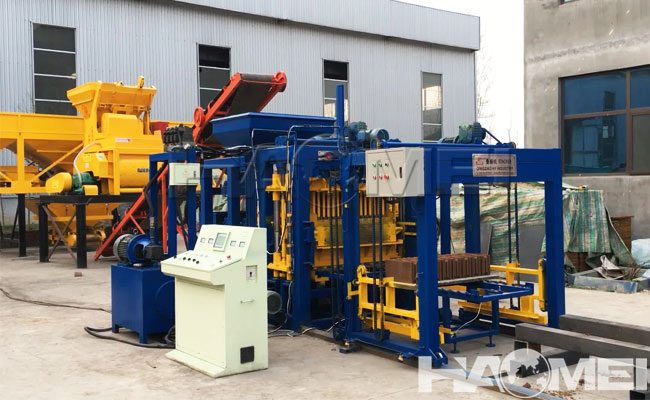
Core capacity and power parameters are the core basis for fully automatic hollow block machine equipment selection. The currently mainstream QT10-15 and QT12-15 models both adopt a hydraulic vibration composite molding process. The
QT10-15 hollow block machine has a rated excitation force of 100-110KN, a vibration frequency of 3800-4500r/min, and a molding cycle of 15-20 seconds. It can mold 10 standard hollow bricks (390×190×190mm) per mold, with a theoretical production capacity of 14400-19200 bricks per 8-hour shift. The main unit's installed power is 48.9-51.2KW. The higher-specification
QT12-15 hollow block machine has a maximum excitation force of 150KN, molding 12 standard hollow bricks per mold, with a maximum single-shift production capacity of 23000 bricks, suitable for large-scale block factories with a daily production capacity of over 20,000 bricks. Both models have a rated working pressure of 21-31.5MPa for their hydraulic systems, with pressure fluctuation controlled within ±1.2%, ensuring stable and consistent molding pressure during continuous production.
Molding accuracy and quality control stability are the core competitiveness of the automatic hollow block machine equipment. The frames of mainstream models are generally welded from Q345B high-strength steel plates and subjected to annealing stress relief treatment, ensuring their deformation resistance meets the requirements for continuous 72-hour full-load operation. The vibration table amplitude error is less than 0.05mm, the thickness deviation of brick blanks on the same pallet does not exceed 0.3mm, and the dimensional tolerance of finished products can be controlled within ±0.5mm. High-end models equipped with machine vision inspection modules can perform millisecond-level identification of brick blank hole integrity, edge defects, and surface cracks, with an accuracy rate of 99.3%. With the linkage of an automatic rejection mechanism, the overall scrap rate of finished products can be stably controlled below 1%, far exceeding the industry average.
Energy consumption and durability directly affect the long-term operating costs of the factory. According to industry energy efficiency assessment data from 2025, the comprehensive power consumption per unit product of mainstream models is 2.64kWh/m³, reaching the Ministry of Industry and Information Technology's energy efficiency benchmark level. Some high-end models equipped with servo hydraulics and variable frequency drives can reduce power consumption to below 2.3kWh/m³, a 18.6% reduction compared to traditional models. In terms of durability, the core mold is made of chromium-manganese alloy steel and vacuum-quenched, with an average service life of over 800,000 cycles. The hydraulic system cleanliness meets ISO 4406 standards 18/15/12, and the overall hydraulic oil leakage rate meets the standard of 98.7%. Under normal maintenance, the main unit can operate without failure for over 8,000 hours.
The wide range of raw material compatibility further amplifies the economic value of the f
ully automatic hollow block making machine equipment. Current mainstream models can stably process industrial solid waste such as fly ash, slag, coal gangue, and recycled aggregates from construction waste, with a maximum blending ratio of 75%-90%, reducing raw material costs while meeting green production requirements. The entire fully automated production line requires only 3-5 operators to complete the entire process control, reducing labor costs by more than 50% compared to traditional semi-automated production lines. Combining production efficiency and operational economy, it is a core standard equipment for modern block factories.




 (Chat Online)



