Fixed Concrete Mixing Plants
Oct 09, 2026
Haomei Machinery’s fixed concrete mixing plants cover a capacity range of 25 to 240 m³/h, categorized into four tiers. The small-scale tier includes models HZS25, HZS35, HZS50, and HZS60, equipped with JS500 to JS1000 twin-shaft forced mixers; these feature discharge capacities of 500L to 1000L and standard mixing cycles of 60–72 seconds. The medium-scale tier comprises models HZS75, HZS90, and HZS120, utilizing JS1500 to JS2000 mixers with discharge capacities of 1500L to 2000L and mixing cycles of 55–60 seconds. The large-scale tier consists of models HZS180 and HZS240, featuring JS3000 to JS4000 mixers, discharge capacities of 3000L to 4000L, and mixing cycles of 50–55 seconds. Across all models, dynamic weighing accuracy for aggregates is ≤±2%, while accuracy for powders and liquids is ≤±1%, complying with EN 206 and ISO 19720 standards.
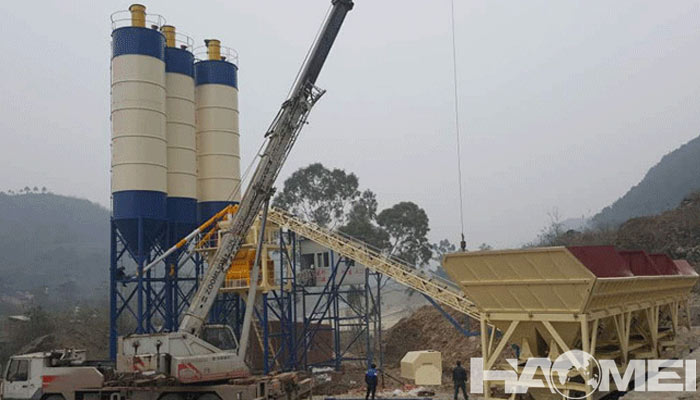
Core Structural Components
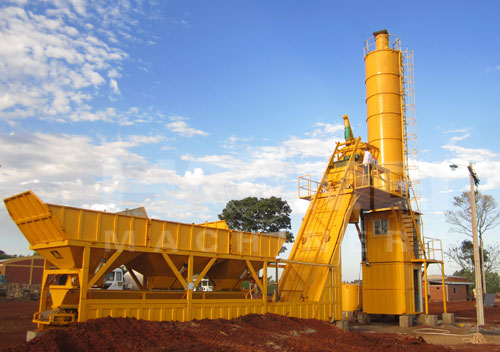
The stationary concrete mixing plant consists of six major modules: the aggregate batching unit, aggregate conveying unit, main mixing tower, powder storage and metering unit, water and admixture metering unit, and electrical control system. Aggregate conveying comes in two configurations: a skip hoist system for vertical feeding (offering a compact footprint, reduced civil engineering costs, and 70%–80% rated output efficiency) and an inclined belt conveyor system for continuous feeding (delivering conveying efficiency exceeding 120 t/h, 85%–90% rated output efficiency, and suitability for continuous mass production). The main mixing tower features a welded structural steel frame, with the main steel structure designed for a service life of over 10 years. Mixer liners and mixing blades are made of thickened high-manganese steel, offering a wear-resistant service life of ≥7,000 hours under normal operating conditions. The entire plant is designed for modular disassembly and transport via standard shipping containers; on-site installation takes 7–15 days, depending on the specific capacity class.
Application Project Types
- Small-scale projects and township-level commercial concrete (25–60 m³/h):
Suitable for rural road networks, rural housing, and small-scale agricultural water conservancy projects with construction periods under one year, as well as township-level commercial concrete supply points. These projects typically require 200–400 m³ of concrete per day, operate in limited spaces, and are budget-sensitive. The HZS35 and
HZS50 are the best-selling models in this category; a skip-hoist (bucket) feeding configuration is sufficient to meet requirements.
- Medium-scale municipal and county-level commercial concrete (75–120 m³/h):
Suitable for urban building construction, municipal utility networks, and road expansion projects with construction periods of 1–3 years, as well as standardized commercial concrete stations serving county centers. These projects require stable, continuous supply and a daily volume of 400–800 m³. The
HZS90 and HZS120 utilize a belt-conveyor feeding configuration; a two-shift production schedule can meet daily supply needs exceeding 800 m³, while metering accuracy and data traceability functions satisfy local regulatory requirements for commercial concrete.
- Large-scale infrastructure and regional commercial concrete hubs (180–240 m³/h):
Suitable for expressways, railways, major water conservancy hubs, large-scale urban CBD developments, and regional commercial concrete hubs with a service radius exceeding 30 km. These projects require 24-hour continuous production, with a single-station annual capacity of 200,000–400,000 m³. The
HZS180 and HZS240 come standard with dual powder silos, high-efficiency pulse dust collection systems, and digital interfaces for production management that can connect to local regulatory platforms.
When selecting a
fixed concrete mixing plant, first calculate two figures: determine the required theoretical capacity using the formula [Average daily concrete volume ÷ Daily operating hours ÷ Actual production efficiency × 1.2 redundancy factor]; then, verify that the site's length, width, and vertical clearance are compatible with the chosen configuration. Over my years in the industry, I have seen many clients blindly invest in high-capacity fixed concrete mixing plant equipment, only to find that less than half of that capacity is utilized on a daily basis—resulting in significant capital tie-up and depreciation costs. Conversely, selecting a capacity that is too low leads to supply shortages during peak periods, incurring even higher costs due to work delays. Haomei Machinery’s engineering team can provide a tailored configuration plan based on your project schedule, daily consumption requirements, and site conditions. We welcome your inquiries.




 (Chat Online)



