Wet Batch Plant vs Dry Batch Plant: Differences & Selection Guide
Oct 12, 2026
Wet batch and dry batch concrete plants represent two parallel technical pathways within the ready-mixed concrete production sector. They differ systematically in terms of batching processes, equipment configuration, storage methods, and target markets; an incorrect choice can directly impact a project's profitability and regulatory compliance. Drawing on Haomei Machinery’s extensive experience in delivering overseas projects, the following analysis compares the two types across four dimensions: process principles, equipment structure, cost structure, and application scenarios.
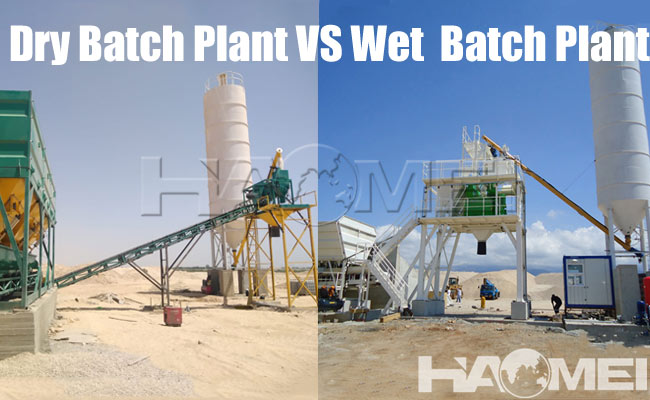
Process Principles:
Wet batch concrete plants combine water, cement, aggregates, and admixtures in the main mixer for forced mixing before the concrete leaves the facility; the discharged product already possesses the required slump and can be pumped and poured immediately upon arrival at the construction site. In contrast, dry batch concrete plants only perform precise metering and mixing of dry materials—such as aggregates, cement, and fly ash—while water and admixtures are added during transit or at the site, with final mixing occurring within the transit mixer drum while the vehicle is in motion. This process distinction directly dictates the core equipment differences.
Equipment Configuration:
Wet batch concrete plants come standard with a twin-shaft forced mixer, featuring a batch mixing time of 30–45 seconds and metering tolerances of ≤±2% for aggregates and ≤±1% for powders and water. The complete system includes enclosed aggregate sheds, pulse dust collection, wastewater recycling, and aggregate separation units; taking the HZS180 concrete batching plant model as an example, a single plant occupies approximately 1–1.3 hectares and is equipped with four 1,000-ton powder silos. Dry batch concrete plants feature significantly simplified main mixing units—often utilizing only horizontal continuous screw mixers or twin-shaft zero-gravity mixers—with mixing power typically just 40%–60% of that required for a wet-mix concrete plant of equivalent capacity. Since the equipment does not handle wet concrete, environmental protection systems are streamlined (wastewater treatment is generally omitted), and the number of powder silos can be reduced by one or two units.
Cost Structure:
The initial investment for a dry batch concrete plant is typically 25%–35% lower than that of a wet batch concrete plant with the same capacity, primarily due to reduced requirements for mixer power, dust collection systems, and environmental protection infrastructure. However, there are significant differences in operating cost structures: for wet batch concrete plants, the effective time window for ready-mixed concrete—from discharge to pouring—is only 90 to 120 minutes (for standard C30 concrete with typical slump), limiting the transport radius to within 15 kilometers; exceeding this time risks the concrete undergoing initial set and becoming unusable. In contrast, dry batch concrete plants produce dry materials that can be stored for 24 to 72 hours, allowing the transport radius to extend to 50–80 kilometers; this increases the average daily turnover efficiency of transport vehicles by approximately 40% and significantly expands the delivery coverage area.
Application Scenarios:
Wet batch concrete plant plants dominate the ready-mixed concrete market in urban cores and serve projects requiring high workability and strength stability—such as building construction, municipal works, and high-speed rail—necessitating coordinated operations between concrete mixer trucks and concrete pumps. Dry batch concrete plants are better suited for remote construction sites, water conservancy projects, rural road construction, and precast component factories where water access is limited or transport distances are long; they offer lower equipment investment costs and greater flexibility in relocation. In some Southeast Asian and African markets, dry-mix plants hold a dominant position due to the immaturity of local ready-mixed concrete supply chains.
Practical industry experience shows that a common pitfall for customers is overlooking local regulatory requirements for ready-mixed concrete. Some countries and regions mandate that water addition and mixing must occur at the plant site, meaning the dry batch concrete plant model fails to meet compliance standards. It is advisable to verify local regulations, transport radii, and project types before investing, and then decide whether to adopt a wet batch concrete plant, a dry batch concrete plant, or a dual-function plant configuration capable of both operations.




 (Chat Online)



