Ready Mix Concrete Plant Capacity Analysis
Jul 27, 2026
The ready mix concrete plant capacity is a core indicator for project selection and operational planning. However, most practitioners' understanding of capacity is limited to the nominal value of the RMC plant equipment model. In fact, ready mix concrete batching plant capacity is divided into three levels: theoretical capacity, rated capacity, and actual operating capacity. The latter often differs significantly from the nominal value.
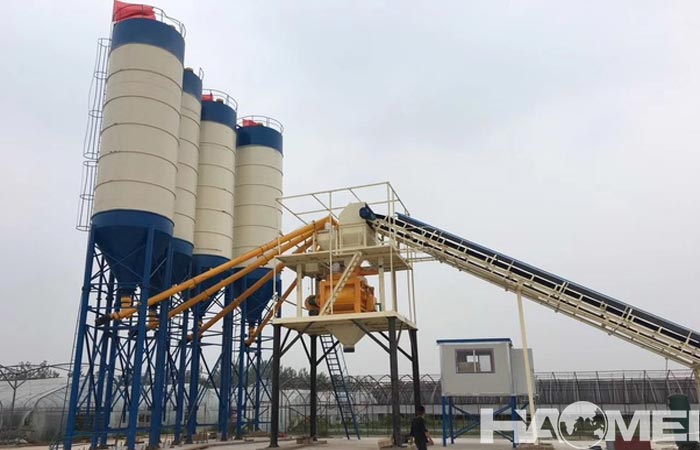
From the perspective of the industry's common nominal system, ready mix concrete plant capacity is based on "theoretical output per hour," corresponding to different application scenarios.
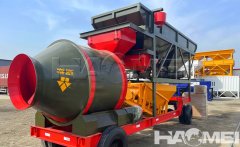
Small ready mix concrete plants have nominal capacities concentrated in the range of 35-90 m³/h, matched with mixing hosts with a nominal capacity of 0.5-1.5 m³, suitable for short-term infrastructure, rural engineering, and small municipal projects, offering flexible deployment and low initial investment.
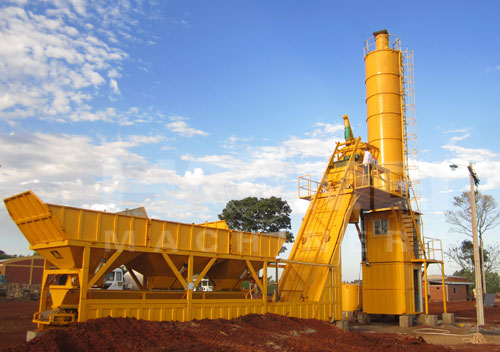
Medium-sized ready mix concrete plant plants are currently the mainstream in the market, with nominal capacities covering 120-180 m³/h, corresponding to mixing hosts with a capacity of 2-3 m³, capable of meeting the daily supply of county-level commercial concrete plants and supporting continuous construction of medium-sized infrastructure projects.
Large-scale ready mix concrete plants have a nominal capacity of 200-270 m³/h for a single production line, and a dual-unit parallel plant can exceed 400 m³/h, equipped with a 3-4.5 m³ large-capacity main mixer. They primarily serve commercial concrete plants in central cities and large-scale infrastructure clusters. It is important to clarify that all nominal values are theoretical upper limits under ideal operating conditions and cannot be directly used as the basis for calculating actual production.
Scientific calculation of production capacity requires distinguishing three levels, incorporating realistic constraint coefficients at each level. The most basic theoretical production capacity formula is:
Hourly theoretical production capacity = Nominal discharge capacity of the main mixer × Theoretical cycle times per hour. The industry-standard theoretical cycle time is 60 seconds per batch, meaning 60 complete cycles per hour. This value excludes all auxiliary loss time and serves only as a unified benchmark for model calibration.
Rated production capacity incorporates a time correction coefficient for normal production, typically 0.8-0.85, covering the auxiliary time for normal metering, feeding, and unloading. It represents the sustainable output level of the equipment under standard operating conditions and a single formula.
Actual operating capacity needs to be multiplied by the utilization coefficient to deduct non-production time such as formula switching, vehicle waiting, equipment downtime, and routine inspections. For well-managed continuous production sites, the utilization coefficient is generally stable between 0.65 and 0.75. To calculate annual capacity, this needs to be multiplied by the daily operating hours and the number of effective working days per year. The industry standard is 300 days per year and 10 hours per day. For example, a nominal HZS120 ready mix concrete plant typically has an actual annual capacity of 230,000-270,000 m3, far lower than the value calculated using simple theoretical conversion.
Actual capacity of ready mix concrete plant fluctuations are influenced by four core factors.
First, the equipment configuration itself: the structure of the main discharge gate, the conveying efficiency of the screw conveyor, and the feeding speed of the metering system directly determine the single-disc cycle time. Equipment using quick-opening arc-shaped discharge gates and multi-screw synchronous feeding can reduce cycle time by 10%-15%.
Secondly, the characteristics of materials and formulations matter. Dry-hard concrete requires short mixing times and has a relatively high capacity. Pumped concrete, high-grade concrete, and formulations containing multiple special admixtures require longer mixing and metering times, resulting in a 10%-20% reduction in capacity. Frequent switching between multiple formulations during production also significantly lowers average output efficiency.
Thirdly, production scheduling is crucial. Smooth connections between concrete mixer trucks and short waiting times for materials result in capacity closer to the rated value; however, if vehicle scheduling is disrupted and waiting times for materials are long, actual capacity may drop to below 50% of the nominal value.
Finally, environmental and operational conditions are also important. High and low temperatures extend auxiliary operation time, and unplanned downtime due to inadequate equipment maintenance directly lowers long-term average capacity.
In summary, the capacity of a ready mix concrete plant is not a fixed nominal figure but a dynamic indicator influenced by multiple dimensions, including equipment, materials, and management. When selecting a model and planning capacity, it is necessary to choose a reasonable conversion factor based on the specific application scenario, rather than simply referencing the model's numerical value, to make a realistic investment and operational plan.




 (Chat Online)



