High Quality Concrete Batching Plant
Feb 09, 2026
With eight years of experience in the concrete batching plant export industry, I have handled the selection, commissioning, and after-sales service of nearly a hundred sets of exported equipment. I deeply understand that overseas customers' judgment of "high quality" is never simply about "production capability," but rather a comprehensive evaluation considering efficiency, precision, durability, environmental friendliness, and adaptability. Considering the usage scenarios in different regions globally (high temperatures in Southeast Asia, dusty environments in Africa, and stringent environmental standards in Europe and America), a high quality concrete batching plant that can withstand market scrutiny must meet specific data standards in the following five core dimensions. This is also our core competitive advantage that distinguishes us from our competitors when exporting.
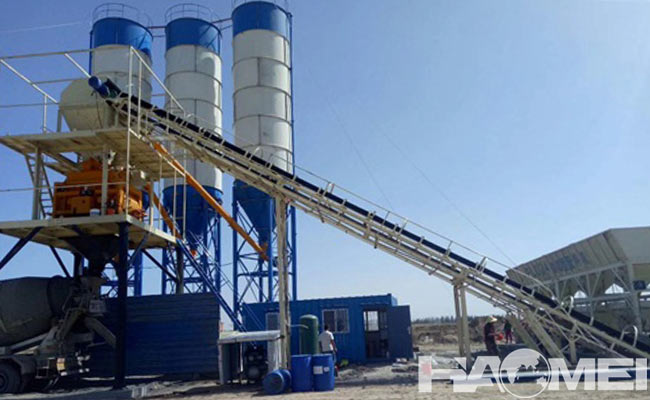
A precise mixing system is the core foundation and the "hard power" of exported equipment. A high quality concrete batching plant's mixing unit must adopt a twin-shaft forced-type structure, and the mixing blades must be made of wear-resistant alloy material with a service life of no less than 8,000 working hours, extending it by more than 40% compared to ordinary materials. The mixing speed must be stable at 28-32 r/min, with a mixing uniformity error ≤5%. The mixing time for each batch should be controlled at 45-60 seconds, ensuring the slump fluctuation of the discharged concrete is ≤±20mm. It must be compatible with the production of C10-C80 full-strength concrete. This is particularly crucial in high-end construction projects in Europe and America and is the most frequently verified indicator by our clients when exporting.
An efficient and stable feeding and metering system determines the equipment's maximum capacity and product consistency. The feeding system must be equipped with a heavy-duty scraper conveyor with a conveying capacity of no less than 120 m³/h, a chain tensile strength ≥1800 MPa, and continuous operation for 72 hours without failure. The metering system should adopt a fully electronic weighing mode, with aggregate metering accuracy ≤±2%, cement, fly ash, and other powder metering accuracy ≤±1%, water and admixture metering accuracy ≤±0.5%, and a metering response time ≤0.3 seconds. This avoids substandard concrete strength due to metering deviations and reduces rework losses in overseas construction.
Durability and adaptability are the "survival bottom line" for high quality concrete batching plants. Considering the inconvenience of sourcing spare parts and the complexity of operating conditions in some overseas regions, the overall protection level of the equipment must reach IP54 or higher. The electrical control system uses a PLC programmable controller, which has strong anti-interference capabilities and can start and operate normally in environments ranging from -10℃ to 55℃. The main bearing adopts a sealed design with a dust protection level of ≥6, suitable for dusty areas in Africa; the hydraulic system operates at a stable pressure of 16-20MPa with a leakage rate of ≤0.1ml/min, reducing the frequency of after-sales maintenance. This is also a key reason why our exported equipment has a better reputation than our competitors.
Environmental compliance is the "passport" to enter the global market. Currently, environmental standards in Europe, America, Southeast Asia, and other regions are continuously improving. High quality concrete mixing plants must meet the following requirements: dust emissions ≤10mg/m³, noise ≤75dB (at a distance of 10 meters from the equipment), equipped with fully enclosed aggregate silos and pulse bag dust collectors with a dust removal efficiency of ≥99.5%; wastewater recovery rate ≥85%, which can be recycled for aggregate washing. This not only complies with local environmental regulations but also helps customers reduce water consumption costs. This is also a core advantage for us in expanding into high-end export markets.
Furthermore, intelligent control and low energy consumption are also indispensable. The high quality concrete batching plant equipment needs to be equipped with an intelligent control system that enables remote control and fault warning, reducing the operational error rate by 60%; the energy consumption per unit of concrete should be ≤7.5kWh/m³, saving more than 15% energy compared to ordinary concrete batching plants.
In summary, the core of a high quality concrete batching plant is to quantify every performance aspect with clear data, balancing efficient production with long-term operation and maintenance. This is also the core logic behind our role as an exporter in providing sustainable value to global customers.




 (Chat Online)



